Demand for solar panels for UK households has grown exponentially in the past decade, and even more in the past few months. With lower manufacturing costs and improvements in efficiency, solar panels have become a viable option for households wishing to produce their own energy.
Much about solar panels remains misunderstood, however, as they are still sometimes perceived as overly expensive and inefficient.
This article will explain what a solar panel is and go through the different types that exist. It will also answer questions surrounding efficiency, solar batteries, and solar panel prices.
We will also discuss some of the schemes available to you to make solar panels more affordable.
What is a solar panel?
Solar panel production used to be very costly, so was rarely used for domestic use. With decreasing manufacturing costs, however, solar panels have become readily available for UK households.
A solar panel is an energy-generating system that converts the sun’s radiation (light) into electricity. Despite some misconceptions, solar panels need only sunlight to function, not the sun’s heat.
A solar panel is made up of photovoltaic (PV) cells. First used in the early twentieth century, these cells are responsible for converting the sun’s rays into an electric current. Let’s take a closer look, now, at the different types of solar panels available on the market.
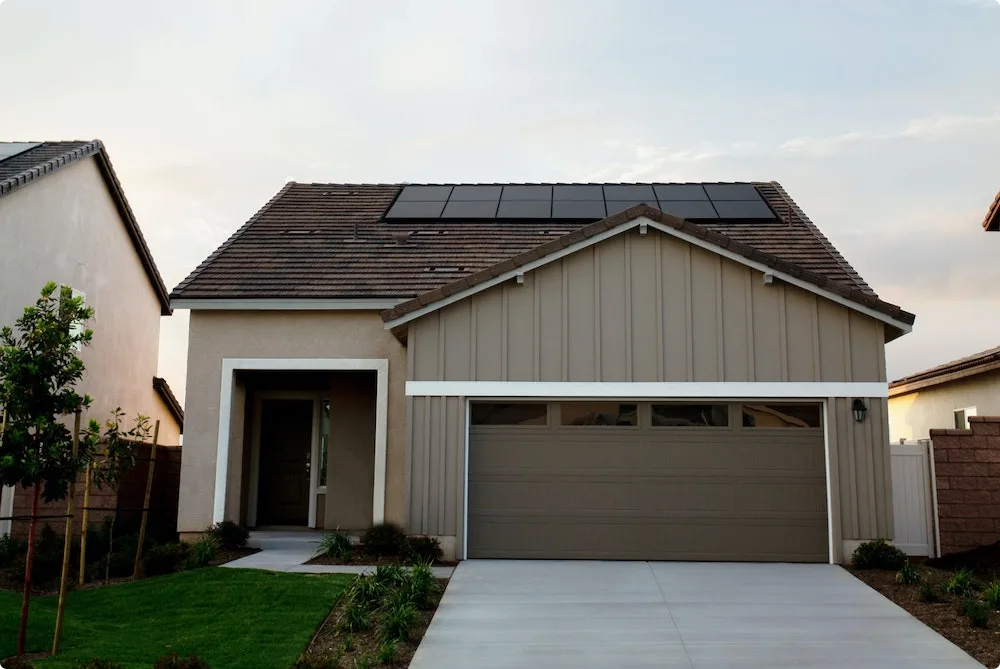
Four main types of solar panels
Monocrystalline solar panels
Monocrystalline solar panels, made from purified silicon, are the most commonly used solar panels in the UK.
Silicon is used in solar panels because of its semiconductive properties, making it neither an insulant nor as conductive as many metals.
Silicon is rendered semi-conductive by the addition of positive or negative charges onto it. For a positive charge, to make a p-type silicon, atoms like boron are added. They have one less electron (which is always negatively charred). Conversely, for a negative charge (n-type silicon), atoms with an additional electron are added.
Silicon is also used since it is one of the most common elements on the planet -- we have a plentiful supply for years to come!
Polycrystalline solar panels
Polycrystalline, like its monocrystalline counterpart, is made from silicon. Its silicon, however, is not purified.
Whereas a monocrystalline ingot is made up of one silicon (hence the prefix mono-), a polycrystalline ingot is a composite of different silicons. Monocrystalline ingots are thus extracted from initial polycrystalline crystals.
Passivated Emitter and Rear Cell (PERC) panels
PERC panels are the most recent advancement in solar panel technology. These panels are made to increase electron intake, so as to maximise the solar panel’s energy production.
PERC panels are, like monocrystalline and polycrystalline panels, made up of PV cells made from silicon. These panels differ, however, in the addition of a passivation layer, used to attract electrons.
The passivation layer is essentially a mirror, reflecting back some of the light that passed through the panel. This reflective layer gives the light a second opportunity to be caught by the solar panel.
Thin-film solar panels
These solar panels are rarely used for domestic purposes. Thin-film panels are not made of silicon, they use sheets of plastic or glass for the panel.
Thin-film solar panels require a lot of space to be efficient, they are thus more appropriate for industrial use than for UK households.
How do solar panels work?
Solar panels work thanks to photovoltaic (PV) cells. These cells are made of the silicon discussed above, and are prized for their ability to both absorb and reflect light -- too much absorption and the panel would overheat, leading to malfunction; only reflection and the panel would generate no electricity.
Electricity is generated in these cells when sunlight comes in contact with them and is converted into electrons. These electrons flow through silicon, creating an electrical current.
With metals, conducting materials that form a grid in the panel, the electrons (electrical current) are extracted from the silicon.
The current that flows through the silicon is a direct current (DC), unsuited to the national power grid. Thanks to a solar inverter, the generated current is converted into alternating current (AC), which can be used in your household.
Read here for a more comprehensive look at how solar panels function.
How efficient are solar panels?
Solar panel efficiency is determined by manufacturers under test conditions. Efficiency is then written as a percentage, depending on the surface area of the panel and the energy produced by the panel.
For example, a test size panel with a surface area of 1m2 and with an efficiency of 23.5% would produce 235 Watts.
Different types of solar panels are available and are differentiated by their manufacturing cost and efficiency -- basically, how much energy they produce. Let’s break down the different panel types and their respective efficiency:
- Monocrystalline panels: they’re the most commonly used panel because of their high efficiency on average--around 22-27%. The pure silicon enables a high production of energy and a long lifespan.
- Polycrystalline panels: less frequently used than their monocrystalline counterparts, they remain less efficient because of the lesser purity of the silicon. Efficiency is, on average, 15-22%.
- PERC panels: precise research on the efficiency of PERC panels remains rather scarce, yet some reports estimate that PERC panels are around 12% more efficient than monocrystalline panels.
- Thin-film panels: these panels are the least efficient option available, at 7-13% efficiency.
For more on the efficiency of solar panels, read here.
How does solar panel battery storage work?
When buying a solar panel, you are given the option to also get a solar battery, letting you store energy produced by the solar panel. Solar batteries are attractive, as they enable you to make the most of your solar panel.
Solar batteries are recommended only if your solar panel produces surplus energy; that is to say, energy your household doesn't consume straight away.
If you have surplus energy--say a bright, sunny day has led to intense solar energy production--you can conserve any excess and consume it when your panel is producing less (during the night, for example).
Solar batteries are great for conserving surpluses, and thus having control over energy consumption, but they also come with some disadvantages.
Whereas solar panels require little maintenance and have a long lifespan (manufacturers will usually insure panels for 20-25 years), batteries last a much shorter time. They will need to be replaced every 5 to 15 years, adding to maintenance costs. This also has an impact on their “eco-friendly” credentials.
Speaking of extra costs, solar batteries represent an extra expense. The price of a solar battery will depend on its storage capacity. For a smaller 3-4 kWh system, you can look to pay around £3,400; for a 9-13.5 kWh, you will pay at least 5,900.
These upfront costs are indeed a lot, but will engender future savings on your energy bills. Since you can conserve energy and consume it as you please, you will be much less affected by soaring bill prices.
If you have more queries regarding solar panel batteries, read here.
How to install solar panels?
When looking to install solar panels for home, you have the option to do it yourself or to call in a professional.
Installing solar panels for homes is relatively quick and straightforward, taking around 2 days in total to complete.
The first step for roof solar panels is to set up scaffolding, so that the installers can safely access your roof.
The installers will then make sure your roof and rafters are strong enough to support the weight of a solar panel. Before making any financial commitment, make sure that your property is suited to a solar panel.
You can get a quick quote from us regarding the structural integrity of your property.
Once structural integrity has been confirmed, installers will go ahead and fasten the solar panel to your roof. If you have opted for a solar battery, the installers will also install it, often for no extra cost!
The installers will make sure that your panel is in the optimal place and at the right angle to receive maximum sunlight.
After the solar panel has been installed, the solar inverter, which enables the inversion from direct current (DC) to usable alternating current (AC). The inverter will be placed by the breaker panel, where all the electrical circuits in your building converge.
You can read more here about solar panel installations.
How much do solar panels cost in the UK?
The price of a solar panel depends on the size of the system, which often determines how much energy is produced (in kWh).
System sizes vary from 3-6 kWh with respective average prices of £5,000-11,000. These are large sums of money, we know, but don’t forget that a solar panel is an investment! With the money you save on yearly energy bills, you can pay back your solar panel within 20 years.
After an expensive initial purchase, solar power homes are more energy independent and less at risk of suffering from rising bills!
For a more precise breakdown of solar panel prices, including installation fees, read here.
By type of system
Solar panel prices also vary depending on the type of system you go for:
- Monocrystalline: although the most efficient and frequently used, monocrystalline panels are also the most expensive. You will be looking at £1-1.5 per watt.
- Polycrystalline: for the same system as the monocrystalline, prices are lower at £0.9-1.
- Thin-film: this is the least efficient option and the one that requires the most space, but it is also the cheapest.
Government grants for solar panels in the UK
Since solar panels are an expensive investment, the government has put in place various schemes to reduce solar panel prices and take the financial strain off of individual households.
ECO4 Scheme
ECO4 is a brand-new government scheme, put into effect in April 2022, that aims to finance low-income UK households’ transition to more energy efficient heating.
The scheme is worth £4 billion and is available to those receiving benefits and living in properties with a low EPC rating.
EPC (energy performance certificate) ratings determine how energy efficient a building is, which includes insulation. Double glazing, thermal curtains and loft insulation are among factors that improve EPC ratings
For more on EPC ratings, read here.
For those eligible for ECO4, energy companies will have to help pay for boiler replacements, loft insulations and to put in place less carbon-polluting energy systems (like heat pumps or solar panels).
Smart Export Guarantee (SEG)
This scheme is available to households with a solar panel AND an associated solar battery.
As outlined earlier, a solar battery lets you store surplus energy. With the SEG, you now have the option to sell some of this surplus back to the national power grid.
Average energy prices under the SEG scheme are around 4-6 p/kWh, which will not be a huge source of income for your household, but will help the repayment of your solar power system.
VAT incentives
As of March 2022, VAT on solar panel purchases have been completely removed for all households. This decision will remain in place for the next five years, until March 2027.
Removing VAT will greatly reduce the price of solar panels, as this tax usually stands at 20%. Under this scheme, households will be looking at hundreds of pounds worth of savings.
This is one of many measures in the government’s Green Deal, about which you can learn more here.
For a complete look at solar panel grants, read more here.
To sum it up
As we have seen, the initial investment in home solar panels has decreased compared to previous years, enabling households to generate their own electricity for free, lowering energy bills and helping ensure energy independence.
Many different factors will affect the final price of your solar panel, the question you need to answer is, do you want to prioritise affordability or efficiency?